IELTS Program
Detailed IELTS Program Description
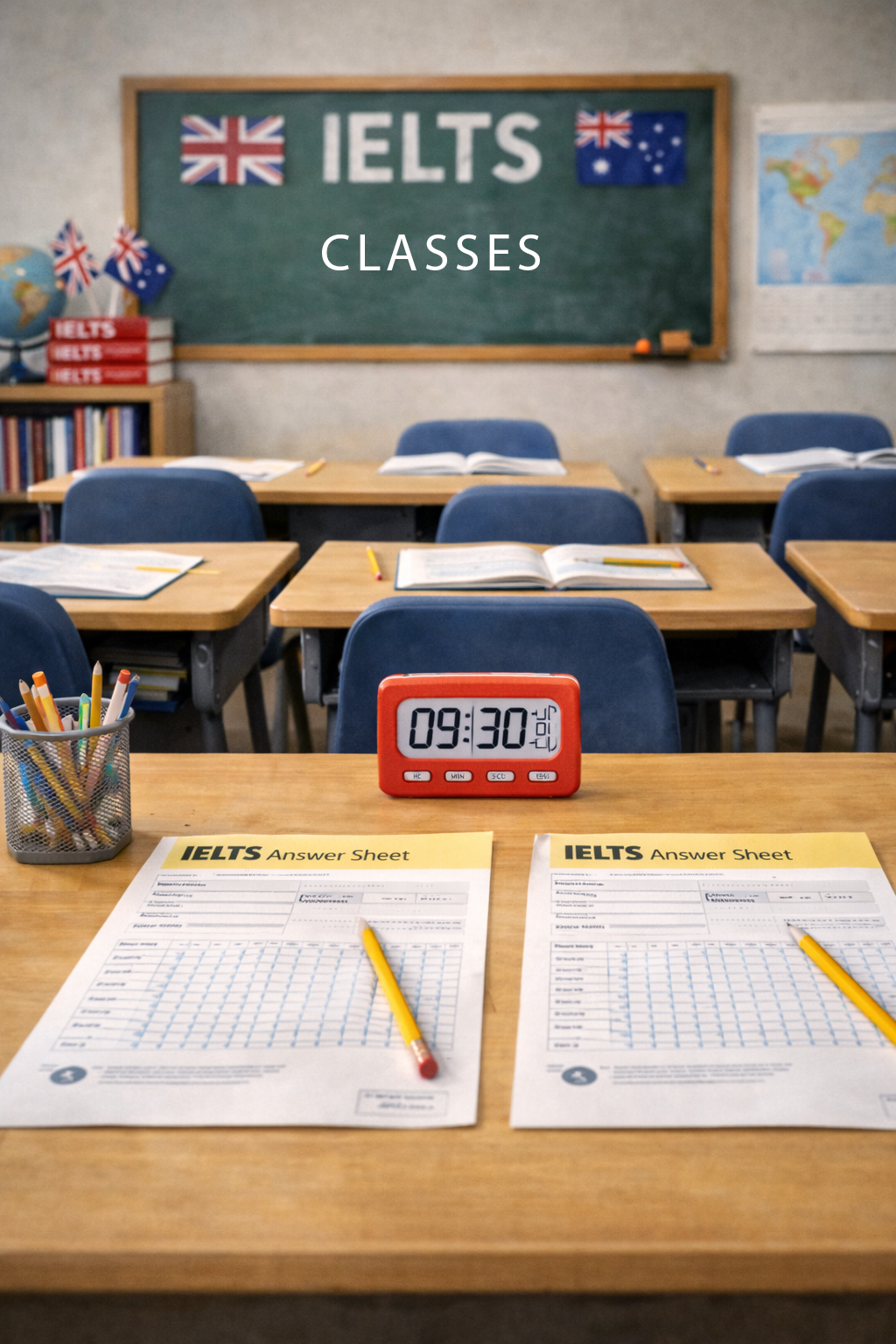
The International English Language Testing System (IELTS) is the world's most popular English language proficiency test, taken by over 3.5 million candidates annually. It measures the ability of non-native speakers to communicate effectively in English for education, employment, or migration.
IELTS is jointly managed by:
- British Council (UK)
- IDP: IELTS Australia
- Cambridge English Language Assessment
2. Versions of IELTS
IELTS Academic
- Suitable for: Students applying to universities, colleges, or professional registration (e.g., doctors, nurses, engineers).
- Focus: Academic English needed for lectures, research, and study tasks.
- Key Features:
- Reading passages from journals, textbooks, newspapers, and research articles.
- Writing tasks include describing data/graphs and writing academic-style essays.
IELTS General Training
- Suitable for: People migrating to English-speaking countries or applying for training/employment.
- Focus: Everyday English for work and social situations.
- Key Features:
- Reading passages include advertisements, notices, handbooks, and workplace documents.
- Writing tasks include formal/informal letters and general topic essays.
3. Preparation Pathway
Most candidates require 6–12 weeks of preparation, depending on English level.
Resources include:
- Cambridge IELTS Practice Books (Academic/General)
- British Council – Road to IELTS (free access after registration)
- IDP IELTS Prep Hub (online practice tests)
- Mobile apps: IELTS Prep by British Council
Preparation Activities:
- Daily practice of Listening, Reading, Writing, Speaking.
- Timed mock tests (once per week).
- Vocabulary building exercises.
- Speaking practice with a partner or tutor.
4. Test Format & Duration
The IELTS exam assesses four language skills: Listening, Reading, Writing, Speaking. Total duration is 2 hours 45 minutes.
| Section | Time | Description |
|---|---|---|
| Listening | 30 minutes (plus 10 mins transfer time in paper-based test) | 4 recordings (conversations, discussions, lectures). Same for Academic & General. |
| Reading | 60 minutes (40 questions) | Academic: 3 long texts from journals, books, newspapers. General: workplace/social texts. |
| Writing | 60 minutes (2 tasks) | Academic: Task 1 – describe graph/table/map; Task 2 – essay. General: Task 1 – letter; Task 2 – essay. |
| Speaking | 11–15 minutes | Face-to-face interview with examiner: Part 1 (intro), Part 2 (long turn), Part 3 (discussion). |
5. Scoring System
Each skill (Listening, Reading, Writing, Speaking) is scored on a Band Scale from 0 to 9. The overall score is the average of the four sections (rounded to the nearest 0.5).
| Band Score | Level | Description |
|---|---|---|
| 9.0 | Expert | Fully operational command of English |
| 8.0 | Very Good | Occasional unsystematic inaccuracies |
| 7.0 | Good | Handles complex language well |
| 6.0 | Competent | Effective command despite some errors |
| 5.0 | Modest | Basic competence; frequent mistakes |
| Below 5 | Limited/Very Limited | Minimal ability in English |
6. IELTS Score Validity (2 Years)
1. Meaning
- Once you sit for the IELTS test, your results (band scores) are considered valid for only 2 years from the test date.
- After 2 years, most universities, immigration departments, and professional organizations will not accept your results.
2. Why 2 Years Only?
- Language ability can improve or decline over time if not used regularly.
- To ensure fairness and accuracy, IELTS limits the certificate validity period to 24 months.
3. Exceptions
Some organizations may accept slightly older results if you can prove ongoing active use of English, but this is rare.
4. What You Should Do
- Plan carefully: Take the IELTS close to the time when you need to submit applications.
- Keep copies of your Test Report Form (TRF).
- If your results expire before your application, you must retake the test.
7. Eligibility & Requirements
- No minimum education level required – anyone 16 years or older can register.
- Valid identification:
- Kenyans: National ID or Passport.
- Foreigners in Kenya: Passport.
- Test Fee (Kenya 2025):
- Paper-based: KES 41,580
- Computer-based: KES 38,760
8. Registration Process
- Go to British Council Kenya or IDP Kenya IELTS website.
- Select Academic or General Training, and your city.
- Choose Computer-delivered or Paper-based test.
- Upload scanned ID/Passport.
- Pay via M-Pesa, bank deposit, or credit/debit card.
- Receive an email confirmation with test date, venue, and preparation materials.
9. Why IELTS? (Recognition & Uses)
- Recognized by 10,000+ institutions in 140+ countries.
- Required for study and migration to many English-speaking countries.
- Accepted for professional licensing in fields such as medicine, nursing, law, and engineering.
10. Additional IELTS Options
IELTS for UKVI (UK Visas and Immigration)
A special version of IELTS approved by the UK Home Office for visa and immigration purposes. It is the same test in content and scoring but is taken at UKVI-approved centres with extra security measures.
IELTS Life Skills
A simpler test designed to prove basic English speaking and listening ability (not reading/writing). Used for certain family or partner visas and some citizenship requirements (A1, B1 levels).